
The article below, written by Mariana Zylberkan and Rafaela Araújo, was originally published in the newspaper Folha de S.Paulo on March 21.
Project Supports Incarcerated Women With No Family Waiting on Temporary Leave Day
By Mariana Zylberkan and Rafaela Araújo, from Tremembé (SP)
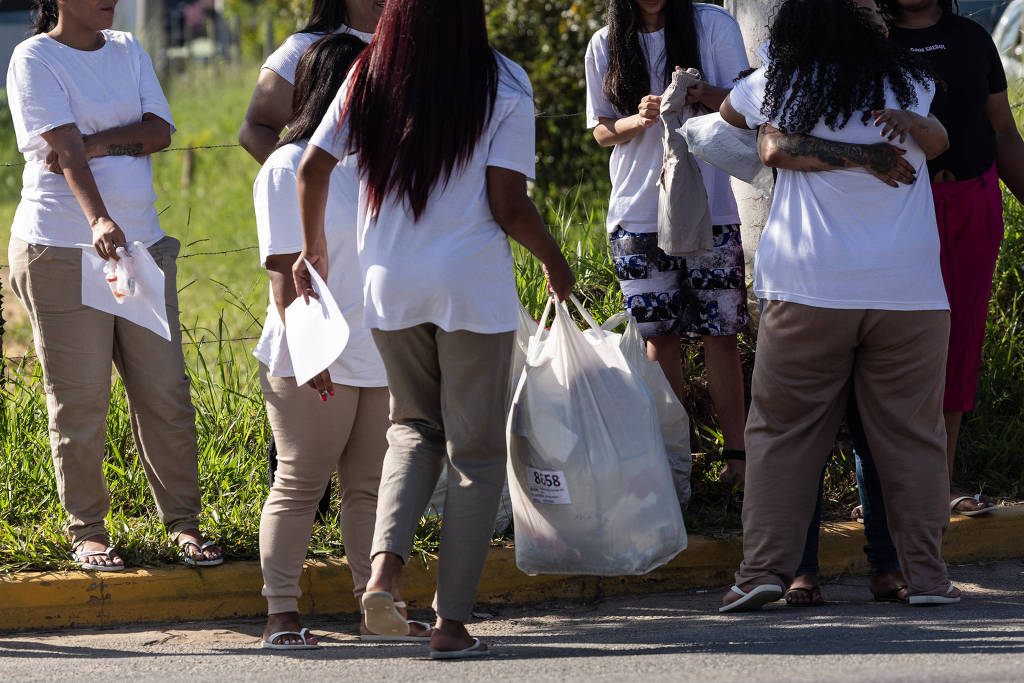
Under a tree, on the median of the highway leading to the Women’s Penitentiary 2 of Tremembé, in the interior of São Paulo — an informal meeting point for relatives of incarcerated women on temporary leave days — social entrepreneur Flávia Maria da Silva, 47, was welcoming former fellow inmates last Tuesday (17), on the first prison furlough day of the year.
Many of these women have no one waiting for them and, dressed in their prison uniforms — white t-shirts and khaki pants — and with no money, it becomes nearly impossible to arrange transportation to their families’ homes, which are often far from the penitentiary, located 156 kilometers from the state capital.
Free for three years, Flávia welcomes the inmates at the exit of the very same penitentiary where she served six years for drug trafficking. “We spend years in darkness, feeling like we’re no longer good for anything. That’s the moment when you see who loves you,” she says. “It’s a surreal moment. You ask yourself, ‘Am I alive? Does this sun exist?'” she continues.
She recalls her own temporary releases to list the hardships she now tries to ease as a volunteer with a Humanitas360 Institute project that offers support to inmates at this moment. “Many leave in their uniforms, which carries a stigma. Hunger is also intense because the last meal of the day in prison is dinner, at 4 p.m.,” she says as she guides the inmates toward a tent set up by the Humanitas360 Institute just a few meters from the penitentiary. To address these challenges, the “Green Doors: Temporary Leave” project has been in place since 2024.
All of them cross through the gates carrying bags with belongings that were not allowed inside the prison — clothes, shoes, cleaning products, and even a brand-new television still in its box. Some, selected by the prison administration, wear electronic ankle monitors.
Upon crossing the penitentiary gate, Silvia, 39, knew no one would be waiting for her. “I only have my mother, and she can’t make it here,” says she, who has been serving time for four years for drug trafficking. “I got involved with crack and ended up stealing to feed my addiction. What I want most right now is to see and take care of my mother,” she continued before accepting the $40 BRL travel allowance from the project to make her way to her family’s home in Cunha.
She and the other inmates mentioned in the report asked that their full names not be disclosed, fearing retaliation.
The structure set up by the institute a few meters from the penitentiary exit offers breakfast, hygiene kits, and snacks, as well as donated clothing and a travel stipend. “I spent years without washing my hair with shampoo. I would stand there in line, hungry, in my uniform, holding a heavy bag, wondering if anyone had come to pick me up,” Flávia recalls.
“Only those who go through this know what it means to find this kind of support,” says Dione, 33, who has been serving time for nine years and left the prison alone last Tuesday.
The seven-day period outside prison is a benefit established by Brazil’s Criminal Enforcement Law since 1984, granted to inmates who have served one-sixth of their sentence and demonstrated good behavior. A recent change in the legislation, however, restricted temporary releases — previously available for family visits during holidays — to only those enrolled in vocational high school equivalency programs, secondary education, or higher education.
The new rule applies to sentences beginning in April 2024, when the law was signed by President Lula (PT), as it is not retroactive. Inmates who were already entitled to the benefit before the legislative change retain that right and may continue to be released on the established dates. A study by the Humanitas360 Institute projects that temporary releases will be fully phased out by 2034.
In São Paulo, the Court of Justice has set 20 temporary release days per year, occurring every three months — not necessarily on holidays, with the exception of the year-end period.
Despite the institute’s support — which also includes legal consultations to review the status of inmates’ cases — most of the women prefer to board a chartered bus parked in front of the tent, headed to the bus stations in Tremembé and Barra Funda, in the western part of the state capital.
About to board, Tamires, 26, made a video call with her nephew on a borrowed phone and let him know she was on her way home to Bananal, in the interior of São Paulo. “You’re going to sleep every day with your aunt, right?” she kept repeating to the child on the call. “The feeling of having the chance to leave and see family again is an overwhelming rush of emotions,” she says, having served eight years.
She explains that she left home at 13 due to constant conflicts with her mother and became involved in crime to survive.
On her second temporary release, Carla, 40, says the anxiety building up to the day manifested physically. “I started scratching myself non-stop — it felt like this day would never come,” she says, serving a 26-year sentence for drug trafficking.
Incarcerated since she was 18, she recounts having escaped from the Butantã Penitentiary, in the western part of São Paulo, during her first detention. “That experience damaged my mental state, but literature helped me improve a great deal,” she said after leaving the Tremembé facility to spend six days with her family in Piracicaba, in the interior of São Paulo.
(Photo credit: Rafaela Araújo/Folhapress)