
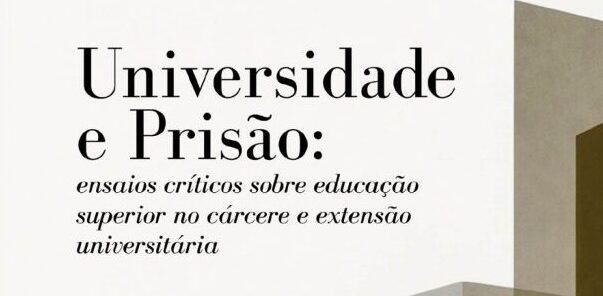
The Humanitas360 Institute is proud to announce its participation in the book “Universidade e Prisão: Ensaios Críticos sobre a Educação Superior no Cárcere e Extensão Universitária” (University and Prison: Critical Essays on Higher Education in Incarceration and University Extension), organized by Sérgio Salomão Shecaira, Bruno Shimizu, Luigi Giuseppe Barbieri Ferrarini, and Jéssica Raquel Sponchiado. The publication grew out of the International Seminar on Education and Prisons, held at the University of São Paulo School of Law in 2025, and was organized by GDUCC – University-Prison-Community Dialogue Group, a university extension project that has long worked to build bridges between academia, the prison system, and society at large.
The book brings together national and international contributions on critical criminology, university extension, and social reintegration, grounded in a central conviction: access to knowledge is an instrument of emancipation and resistance. It is in this spirit that H360’s president and lawyer, Patrícia Villela Marino, and the Institute’s legal consultant, Larissa de Melo Itri, co-authored one of the book’s chapters.
The chapter, titled “Between Bars and Possibilities: Work, Education, and Resistance to Female Incarceration at Instituto Humanitas360”, begins with a historical and structural analysis of the vulnerabilities faced by women workers — from nineteenth-century factories to what is known as the “feminization of poverty” — to show how female incarceration in Brazil is, to a significant extent, a punitive extension of social exclusion.
Building on this diagnosis, the authors present the concrete experience of the Entrepreneurship Behind and Beyond Bars program, through which H360 created and supported social cooperatives inside prison units in states such as São Paulo and Maranhão. The initiative provided incarcerated women not only with dignified income generation, but also with access to formal education integrated into their work schedules.
The article demonstrates that by bringing together cooperativism, economic autonomy, and learning, the program managed to break the exclusionary logic that forces incarcerated women to choose between working and studying — and that 53% of the members of Cooperativa Cuxá, in Maranhão, went on to pursue further education after the experience. For the authors, education in prison is neither a privilege nor a reward: it is a right, and exercising it is also a political act of resistance.
The book launch will take place in São Paulo on May 28th at 6 PM (Brasilia time), at Livraria D’Plácido, located on the ground floor of Conjunto Nacional (Avenida Paulista, 2073). Further information about the publication is available on the Editora D’Plácido website.